

Photos by Rachel Lettre
~Robin Wall Kimmerer, Braiding Sweetgrass
Over the course of three days in August, forty-two people gathered in Stokes State Forest at the New Jersey School of Conservation (NJSOC) for 2024’s Emerging Leaders’ Summit (ELS). The facilitators and ATC staff were joined by thirty-four young adults. These emerging leaders — from eleven different states, diverse backgrounds, and at varying educational and professional stages of their lives — were brought together by common threads: their respect for the natural world, a desire to protect it, and a passion for making the outdoors and the Appalachian Trail a welcoming place for all.
Photos by Rachel Lettre

~Robin Wall Kimmerer, Braiding Sweetgrass
Over the course of three days in August, forty-two people gathered in Stokes State Forest at the New Jersey School of Conservation (NJSOC) for 2024’s Emerging Leaders’ Summit (ELS). The facilitators and ATC staff were joined by thirty-four young adults. These emerging leaders — from eleven different states, diverse backgrounds, and at varying educational and professional stages of their lives — were brought together by common threads: their respect for the natural world, a desire to protect it, and a passion for making the outdoors and the Appalachian Trail a welcoming place for all.
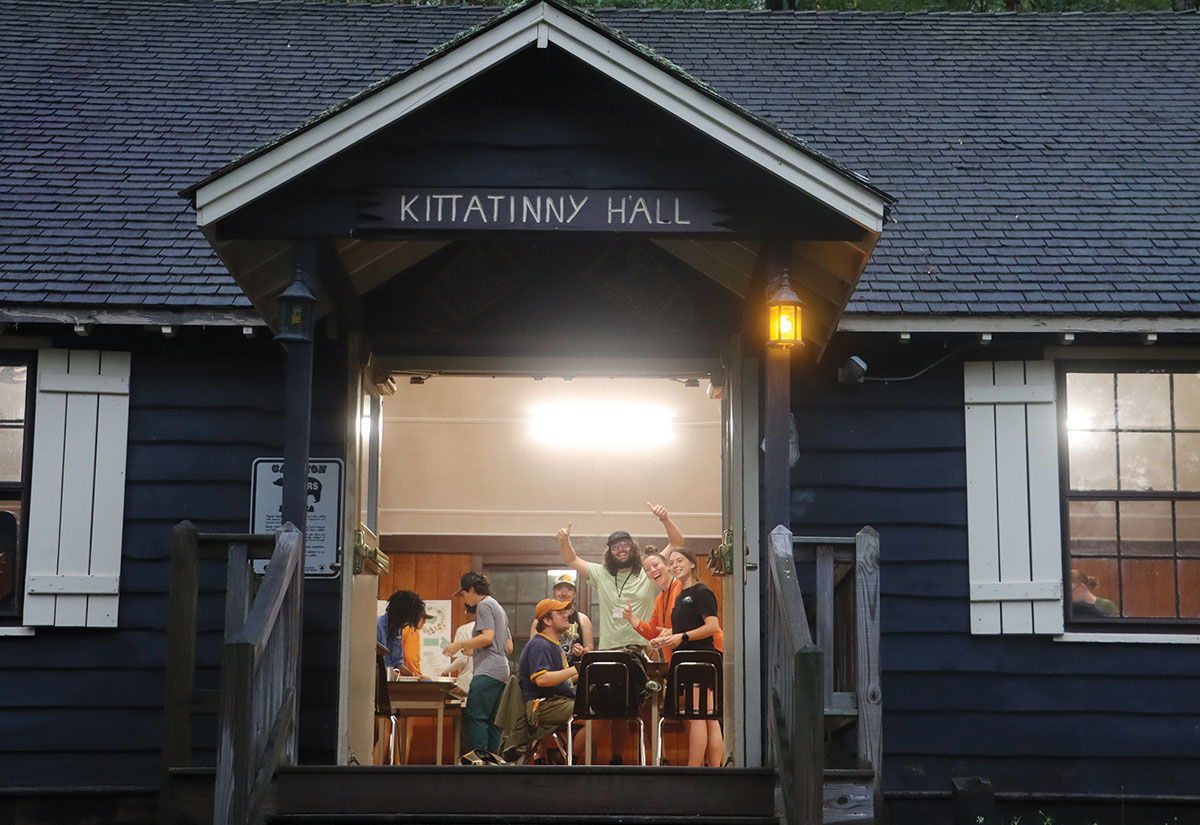
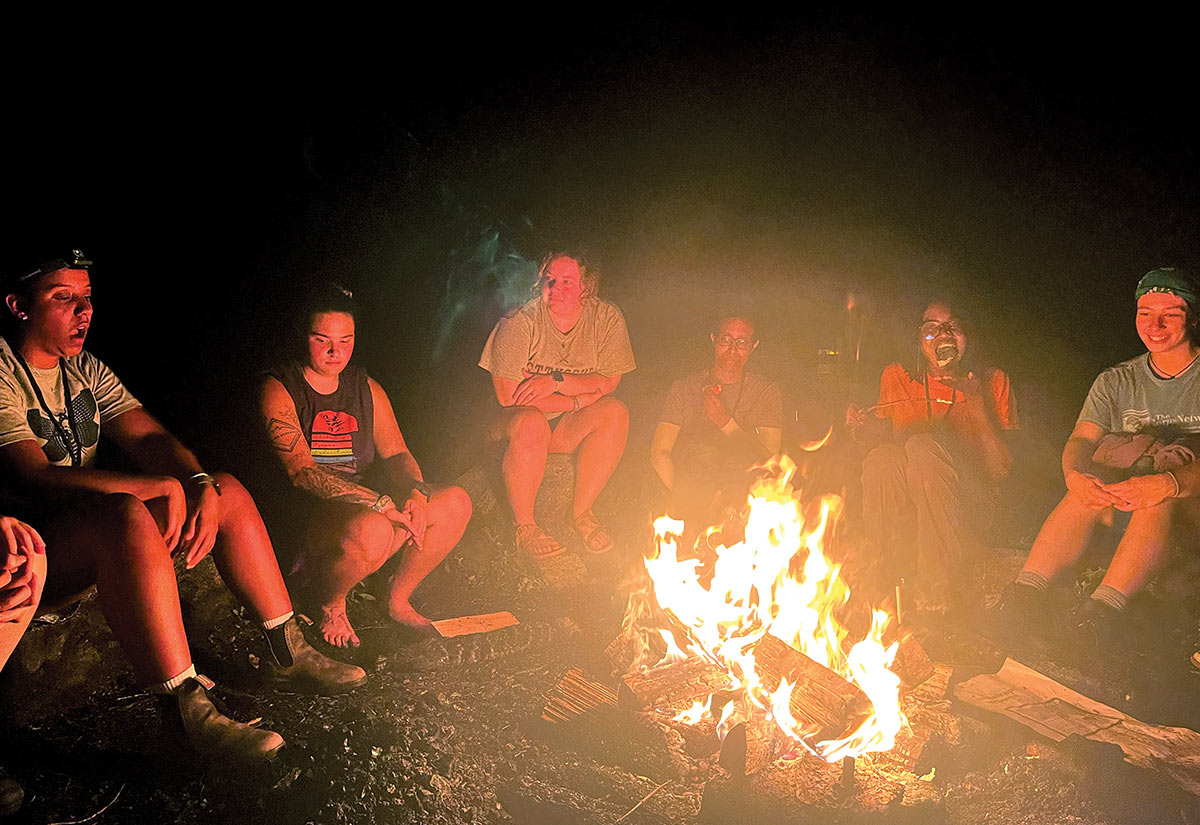
The Emerging Leaders’ Summit is one of the ATC’s programs geared toward encouraging the next generation of Trail conservationists. First held as a virtual gathering in response to the pandemic in 2021, since 2022, annual in-person summits have been hosted at different locations in New Jersey. For many, meeting fellow outdoor advocates was a highlight of the program: “This summit was a great experience and I had so much fun meeting new people with similar passions and goals as myself. I enjoyed really painting a picture of where I belong within the ATC’s work.” Kittatinny Hall photo courtesy of the ATC

The ELS participants — who ranged in age from 18 to 30 — included college students, recent graduates, and young professionals. Some attendees have completed thru-hikes, some serve as A.T. Trail Club volunteers, and some are A.T. ridgerunners. Many represented outdoor organizations, including Southern Appalachian Wilderness Stewards (SAWS), SCA Pennsylvania Outdoor Corps, Shenandoah National Park, Groundwork Elizabeth, First Landing State Park, Philadelphia Outward Bound School, Appalachian Mountain Club (AMC) Boston, the New York-New Jersey Trail Conference, and the Maryland Conservation Corps. As a seasonal National Park Service employee from West Virginia says, “We all come from different backgrounds, but each of us has something unique to offer the A.T.”
Even if they aren’t connected to specific organizations, all have a love of the outdoors. “As a newbie, I felt not just supported — but welcomed — into this vast new world of possibilities. I met so many people in the field, as well as people who were just like me, getting started and looking into what they could do for the outdoors. It was eye-opening,” shares an emerging leader from New Jersey. And while most participants had A.T. experience, five took their first steps on the Trail during the summit.
In addition to continuing to foster a diverse and inclusive environment, this year’s summit emphasized the importance of conveying the ATC’s mission. The agenda for the three days was filled with activities guided by the Conservancy’s work. The summit’s goals were also adapted to incorporate the ATC’s current strategic pillars:
Protect: Emerging leaders learn about the work the ATC does and how they can get involved.
Experience: They explore the Appalachian Trail while gaining new stewardship and outdoor skills.
Belong: They connect with and are inspired by others in a supportive environment.
“It’s really important that the participants understand what the ATC does and what it stands for — how our work stretches across the Trail and beyond,” says Rachel Lettre, the ATC’s Mid-Atlantic Regional Director. “We’ve structured the ELS so it’s not only an opportunity to educate, but to collaborate. They can take what they learn about the ATC and from each other and apply it to their lives or careers. For those connected to other outdoor organizations, it’s also an opportunity to learn about shared goals and see how the ATC can expand partnerships.”
“The contributions of all the different staff and volunteers were essential to making the summit a success,” says Lettre. “And having ridgerunners present their experiences provided some participants with new understandings. Most assumed that ridgerunners only work on the A.T. They were surprised to learn that ridgerunners also share their knowledge off the Trail, including during programs like these.” When asked, a participant said that they considered themselves to be well-versed in Leave No Trace, but they “appreciated the detail that the ridgerunners shared with real-life examples.”
This shared knowledge flows both ways. Summit educators also learn from the emerging leaders — whether it’s gaining a new understanding of how information is received or finding new ways to impart vital Trail trainings. According to Hope Schrouder, a New Jersey ridgerunner, “The ELS encompasses many of the goals that ridgerunners are trying to accomplish while out on the Appalachian Trail. We connect with visitors from a multitude of backgrounds and age groups with differing levels of hiking experience. The summit is so beneficial because it empowers participants to recognize the impacts of a single person from a Leave No Trace perspective. I can’t stress enough the profound importance of a single person. All of us have started somewhere in our relationship with the outdoors and the trails. There’s this innate part of us that longs to be out in nature and to connect with it, but knowing how to do it in a way that protects and preserves for years to come is key….I don’t shy away from giving examples of times when I haven’t always done a great job with Leave No Trace in the past. Explaining that empathy goes a long way with education. I believe that most people want to do the right thing, but often simply don’t know that what they are doing has negative impacts.”


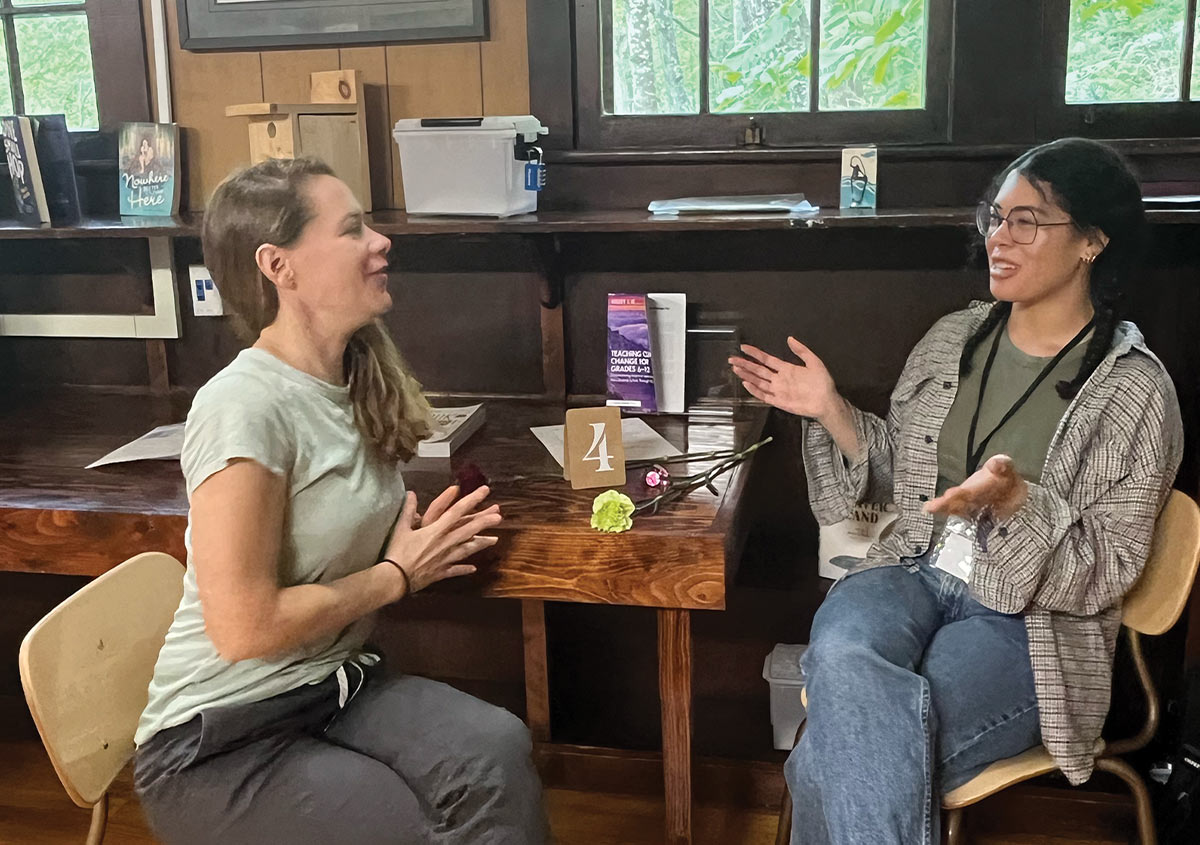

With an eye on exploring Trail-related careers, members of the NextGen Advisory Council set up a Career Panel and a Speed Networking activity. With a format similar to a speed dating event, attendees were moved from partner to partner, sharing their experiences along the way. One participant, who is a college student, found that their “biggest takeaway is what [they] learned about opportunities within the ATC and related careers.”
As a result of these career workshops, an ELS participant who volunteers with their local Trail Club realized they could take their role as an outdoor educator more seriously. In the past, they had joked around, saying they were just the ranger who helps people to have fun, “I wasn’t giving myself the credit for the impact I would hopefully have on those interested in connecting with the natural world around them…It changed the way I view myself in the context of environmental education and looking at outdoor education as a legitimate career path. It invigorated my passion to explore new areas of work within the field while also…being the best I can be in the job I am currently in.”
An emerging leader who works in AMC’s Boston office described the experience and the career discussions, “[It was] basically the first crash course I’ve formally gotten describing cooperative management systems and how trail maintenance gets done on a larger scale. This weekend has really affirmed for me the necessity of facilitating effective partnerships to do good/equitable conservation work. I have a new appreciation for the volunteers at AMC that keep our trails running and the entire network of conservation organizations that we are a part of. I am hopeful that the ELS will kick off some new partnerships for me as well.”


One emerging leader believes that, “The summit gave us the tools and resources to advance the mission of the ATC. The ELS empowered me and other young adults to take an active role in conservation and outdoor recreation by providing us with the resources and knowledge needed to make a positive impact on our communities.”
A student from New Jersey echoed what many participants felt, “Being able to connect on a personal and professional level with individuals from all different backgrounds and coming together for a cumulative purpose — the goal of protecting and creating inclusivity in the outdoors — has changed my perspective of the work I can do every day to make the world a better place.”
Thanks to donations from members, partnerships, and sponsorships from different organizations and corporations, the ATC is able to offer programs like the ELS. Lettre stresses that the goal is to ensure there are no barriers for participants to attend the summit — their transportation is covered and necessary supplies are provided. For example, in support of the 2024 ELS, Osprey generously provided backpacks for the participants to use on their hikes during the summit and beyond. Additionally, the ATC received a grant from the Partnership for National Trails System (PNTS) to fund an intern to assist in coordinating the summit.
If you have questions about the Emerging Leaders’ Summit, please contact [email protected]

Perception may not be the complete truth, but these optics are my reality. Recently, I found myself straightening my blazer and noticing a bit of dirt under my nails from my time on the A.T. The trailhead was only 10 miles from where I stood, but — in that moment — it felt worlds away. Was I meant to be here? Was I supposed to be so buttoned up? Am I “Executive Briana” or “Hiker Bria”? Did I sell out? That question bothers me the most.
Planning and participating in the ELS as a NextGen member helped to quiet this anxiety. Many young people experience similar feelings, so it was beneficial to have these discussions and affirm that I am not alone. The outlier effect that I can experience in a boardroom may be what some of my peers experience on the Trail or also in their professional spaces. But we are stronger when we come together and champion for our inclusion. And the Trail benefits from our passion when we protect and promote it. Our challenges as young people are valid. Sharing our experiences — not only with each other, but with ATC staff and members of the A.T. community — offers new and hopeful perspectives. The Summit allows us to disengage from the noise of the world and step on the Trail together to connect as our truest selves. It is in this deep and intentional dialogue that we find inspiration and strengthen our dedication to the Trail and our community. I hope that the ELS continues as an annual tradition so that more participants feel a renewed commitment to the Trail, as well as greater confidence in pursuing both personal and career endeavors.
I noticed more dirt under my nails today, but this time it made me smile. I feel less torn. I do not need to choose between these spaces. I belong and meaningfully contribute to both. All of my time on the Trail makes me stronger in the office, just as my time in the office puts confidence in my footfalls on the A.T. As I learn to speak up in meetings, I also learn how to speak up for the Trail community. I am patient, thorough, and focused on reaching the peak. But I am also enjoying the journey along the way. I know to pack light and put down what does not serve me. And, most importantly, I know to leave no trace. Or — if I must — that I leave every person, team, and trail better than the way I found it. At the end of the day, we are all passing through. How incredible that in all the fabric of time and space, we are on this hike together.
Briana Apgar is a Next Generation Advisory Council Member who serves on the DEI and Advancement Committee. She is the Program Manager and a faculty member for the Carilion Clinic Biodesign Program at Virginia Tech. Her career focus is health equity and community resilience and outreach. Apgar has an MBA from the University of Virginia Darden School of Business and a Master of Public Health degree from Virginia Tech. She also volunteers as Vice President for Girls on the Run of Central Virginia the Blue Ridge and is a member of the Junior League. Photo courtesy of Briana Apgar