

Building Connection, Community, and Common Ground
“We need the big sweep of hills or sea as tonic for our jaded nerves … Recreation in the biggest senses — the recreation of the spirit … the spirit of fellowship and cooperation.”
— Clarence Stein, Chairman of the Committee on Community Planning, American Institute of Architects (AIA), writing about the Appalachian Trail
A black and white photo of a group of people hiking a steep, muddy trail winding along a riverbank in a bare, winter forest environment.
A group of hikers make their way along the Trail from Harpers Ferry, West Virginia, to Brunswick, Maryland in 1944.
Photo by Abbie Rowe/U.S. National Park Service

By Heather B. Habelka
“T
he Trail is not just for intense hiking, backpacking trips, or day hiking. It’s for the dreamers. It’s for anyone who simply wants to touch the Trail. Everyone is welcome here,” shares Dakota Jackson, ATC’s Senior Director of Visitor Engagement. This sentiment speaks to the heart of Appalachian Trail Conservancy’s mission that has, for 100 years and counting, created communities, cultivated a sense of belonging, and maintained meaningful connections.

Serving as the hub of these connections are the ATC’s three visitor centers located in Virginia, West Virginia, and Maine. Each center is staffed by Trail experts with deep connections to the region and within Trail communities. For many hikers, visitors, and tourists these centers serve as their one — and in many cases, sole — point of contact.

“The mountain people I met along the Trail were kind, hospitable, and interesting…. My faith in mankind was renewed.”
— Eugene Espy
Volunteers and attendees interact at an outdoor Appalachian Trail information tent, where a man signs a form on a green-covered table.
The ATC’s commitment to building community and fostering belonging extends beyond the Trail. Each year, ATC staff and volunteers participate in community- focused events.
Photo by Emily Mayo/ATC
“My department does an excellent job leading someone through any and all aspects of the planning process. It’s being an expert resource combined with a personal touch,” explains Jackson. “I’ve received text messages from people we talked to two years ago with photos of them on top of Katahdin or in Georgia having a great time. I fielded a phone call from folks who live in Ohio who wanted to take a drive simply to see a white blaze. This speaks to how strong the pull of the Appalachian Trail is.” To that end, Jackson together with her staff of eight and a robust roster of volunteers, served more than 30,000 in-person visitors, responded to 2,000 phone, email, and web inquiries, hosted more than 3,000 program and special event attendees, and welcomed visitors from 14 countries outside of the U.S. in 2024. Her department is funded primarily through annual membership dues.

Off the Trail, Jackson’s team participates in events that support Trail business communities, staffs local and regional events including community pop-ups and festivals, supplies brochures to rest stops and welcome centers, and designs signage, information kiosks, and exhibits. “I’ve been working with volunteers to offer programming that will interest the off-Trail community,” says Melanie Spencer, Harpers Ferry Visitor Center Supervisor. “We held one recently on living with bears. We’ve been leading birding walks. We offer programs on local flora and fauna and we’re planning yoga and mindfulness in the forest. We’re also creating a pollinator garden and honoring our native lands through an interactive display.”

The visitor engagement team also creates and distributes Trail-wide, regional, and local messaging. According to Emily Mayo, Visitor Center Senior Manager, “One of our regular tasks is to communicate Trail-wide initiatives and alerts so our staff and volunteers in all three centers are equipped to answer questions from the public, from our members, and from our donors.” According to Mayo, “Mixing ways people digest information in our centers, whether that’s through face-to-face interactions, video and audio, or touchscreen navigation helps visitors take in more information. We’re ensuring our QR codes and digital kiosks work offline, so hikers and visitors can access information even when our facilities aren’t open, such as during the early morning hours. I think our team does a really good job of communicating what visitors are asking for, what information we need clarity on, or where we may need to readjust to meet visitors where they’re at.”

Five young women, smiling and gathered around a table with snacks, pose together inside a rustic cabin with wood-paneled walls.
Trail-related programs — run by the ATC and its partners — bring together people with different backgrounds, at varying educational and professional stages in their lives, and with wide-ranging trail skills and familiarity with the A.T.
Photo by Rachel Lettre/ATC
The visitor engagement team also leads ATC’s retail arm both in the three visitor centers and online, and takes an active role in brand partnerships and programming with mission-aligned organizations and corporations. “Our visitor centers play a key role in communicating broader tourism initiatives by the Forest Service or Park Service to Trail businesses and the local community, because we have built those connections and relationships,” says Mayo. However, this work is not limited to the logistics of trip planning, hiker education, and tourism promotion. The visitor engagement team works to keep all who set foot on the Trail — and those who live in Trail communities — safe. Staff and volunteers conduct responsible recreation programs such as Leave No Trace, disseminate real-time emergency alerts, and coordinate incident reporting in partnership with the National Park Service (NPS).

“Nine times out of 10, we’re the first organization to hear about occurrences on and off Trail. Our partners rely on us for updated information,” stresses Jackson. One example is the ATC’s annual collaboration with local public health officials and the NPS to prepare hostels, shuttle providers, local A.T. Clubs, and Trail communities for the norovirus outbreak. The outbreak occurs every spring along the Trail’s southern region and, according to Jackson, can pose a real danger to hikers, especially in the backcountry.
Three Unique Visitor Centers
By Dakota Jackson
The Appalachian Trail Conservancy operates three visitors centers along the Trail. Each is staffed with a dedicated team who are experts on the Appalachian Trail and regional opportunities. Come in for hiking information, some A.T. swag, and fascinating exhibits.
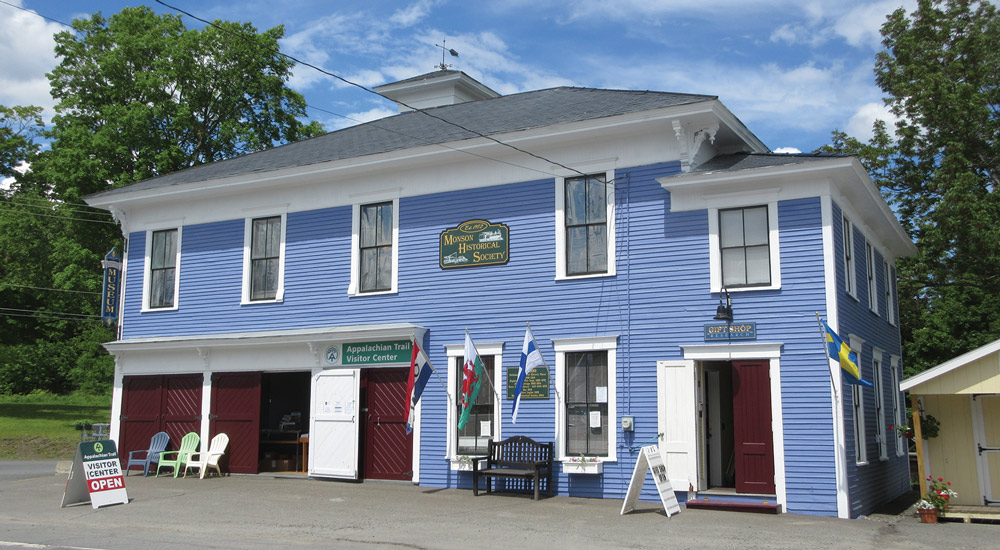
A bright blue, historic two-story building that houses both the Appalachian Trail Visitor Center and a local historical society/museum.
  1. The Monson A.T. Visitor Center was established in 2016 and is the ATC’s northernmost visitor center. Seasonally open from June through October in Monson, Maine, at the southern end of the 100-mile Wilderness, the visitor center prepares long-distance northbound hikers for summiting Baxter State Park. All visitors can learn about the wonderful outdoor opportunities Maine has to offer.

  • The Harpers Ferry Visitor Center & ATC’s Headquarters has been the spiritual halfway point of the A.T. for hikers since the 1970s. Visitors can learn about local recreation opportunities, as well as the history of the Appalachian Trail. In 1978, ATC staff member Jean Cashin started taking polaroid photographs of long-distance hikers. This tradition continues to this day. Visitors can see the thousands of hiker photos in the visitor center Hiker Lounge.
    1. The Damascus Trail Center in Southwest Virginia opened in August 2022. A collaboration with the Town of Damascus, the center is home to exhibits about the extensive outdoor opportunities in the region, a classroom for programs and rotating exhibits, as well as a workshop for volunteer trainings and outings.
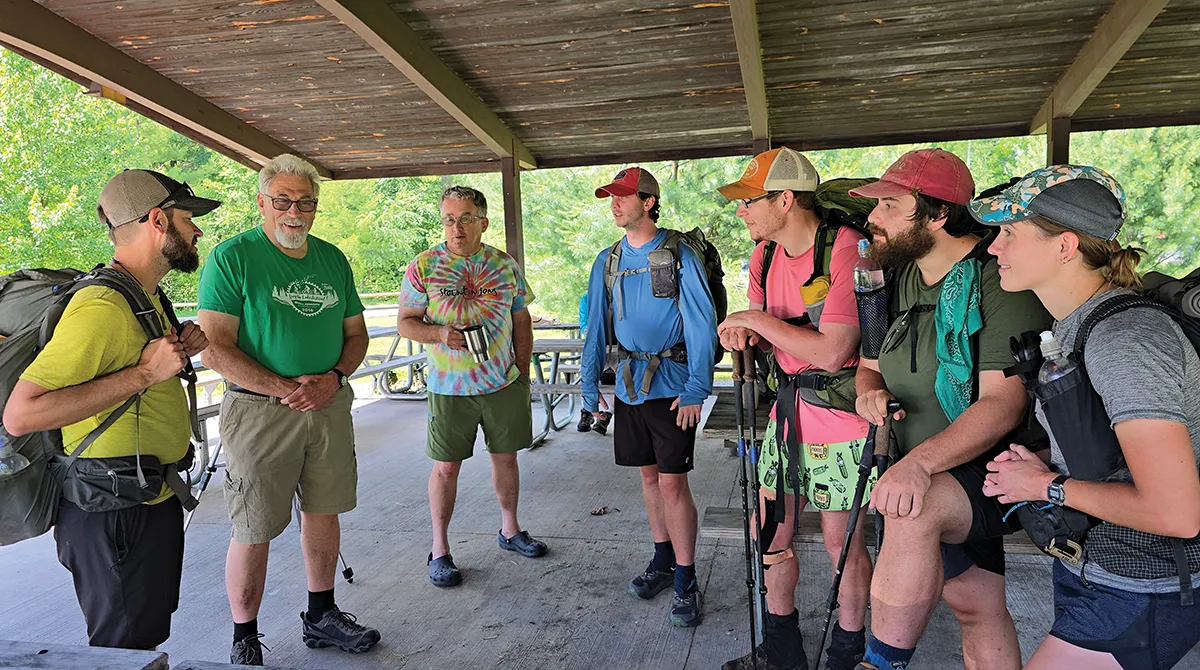
    A mix of six hikers, some heavily packed, and two casual visitors talk under a wooden pavilion roof on a sunny day.
    When asked about her hopes for future hikers and the Trail, Class of 1974 thru-hiker Elizabeth Train shares, “My hope is that the footpath remains accessible to all and is preserved with the intent of the original champions who worked so hard to protect it. I hope that the trail experience remains a deeply personal one for everyone who uses it, but everyone has a responsibility to treat it with great respect — and that its rich biodiversity continues to be protected.” Here, two of her fellow Class of ’74 thru-hikers — Steve Inkel and Mark Doty — trade stories with 2024 thru-hikers during a gathering in Pennsylvania.
    Photo by Katherine “Bear Cub” Rohlfing
    Maintaining Connection in a Digital World
    Recognizing that today’s communities are global, and live both online and on Trail, Jackson’s team has become a trusted resource for the hiking apps AllTrails and FarOut. “It’s critical for us to be part of those communities, to share accurate and timely information, and to work closely with those companies,” she explains.

    While these outreach efforts and relationships are key to keeping the Trail alive, this digital presence has not diminished the time-honored methods of communication that are woven into every aspect of her department’s work. “I take phone calls from people who’ve watched YouTube or gone online but want to talk to an expert, with an actual person,” says Caitlin Miller, Information Services Manager. “There’s so much information out there. We do a really good job of cutting through the noise. We know what’s going on. We’ve hiked the Trail and we speak to each hiker’s experience level. Hearing them become more confident as we talk is what I love. I know they’re going to have an incredible experience on the Trail.”

    In addition to answering phone calls, other community-centered traditions include the ATC’s annual guidebook and hiker photos. Jackson explains, “We’ve been selling guidebooks since the 1930s. That was a prominent part of the ATC’s work early on, a way to gather community and promote the cause of the A.T.”

    In the late 1970s, Jean Cashin — one of the original staff members at the Harpers Ferry headquarters — brought her Polaroid camera to work. She started capturing and archiving photos of long-distance hikers. “While the technology of how we do this has evolved, we still take these photos and capture hikers’ stories. Visitors can see the thousands of hiker photos in the visitor center hiker lounge. There is this sense of tradition in a lot of the work,” Jackson shares.

    Just recently, a thru-hiker who hiked the Trail before starting college in 1997 visited Harpers Ferry with his son. Dave Tarasevich, Visitor Services Representative, helped him locate his Polaroid from 1997. “He hopes his son will hike the Trail or find his own epic adventure early in life,” shares Tarasevich. “The Trail is a way to find out how little you need to find so much about yourself.”

    “There is a feeling of always being surrounded by all the good things, like love and peace and joy. It seems like a protective surrounding, and there is an unshakeableness within, which takes you through any situations you need to face.”
    — THRU-HIKER MILDRED NORMAN, ALSO KNOWN AS PEACE PILGRIM
    A hiker in sunglasses and a jacket holds up a "Flip Flop Festival" sign and cheers outside the Appalachian Trail Conservancy Visitor Center.
    Lee “All Good” Keegan celebrates with other Trail lovers at the Flip-Flop Festival at the Harpers Ferry Visitor Center. For many, getting on the Appalachian Trail — whether it’s a traditional thru-hike, a flip-flop hike, section hikes, or day hikes — inspires them to give back to the A.T. and the Trail community.
    Photo courtesy of Leanna Keegan
    Finding Common Ground
    One of the challenges in today’s online world can be finding like-minded people to form offline connections with. “The AT community continues to evolve with time, but there’s always been this thread of personal touch that speaks to the staff, and to the quirkiness and vitality of the A.T. community,” says Jackson. The ATC’s affinity lists are an example of this vitality, and the Trail community’s generosity. Compiled from the 2,000-miler application, this database matches experienced hikers with less experienced ones based on shared experiences, interests, or backgrounds. “We have a flip-flop affinity list and an LGBTQ+ affinity list. We’ve connected women over fifty, vegetarians, hikers with disabilities, injuries, or health conditions, and those hiking with their dogs,” explains Miller. “A good example of the affinity list in action is when we have international hikers reach out with specific questions that we aren’t equipped to answer. We can connect them with an experienced hiker from their country.”

    Jackson agrees, “We’re able to provide space for human connection, not just with us, but with other members of the hiking community and the local communities.” This holds true for Leanna (Lee) “All Good” Keegan. In 2023, she completed a flip-flop thru-hike. From her first hiking-101 email inquiry to the ATC, she felt she was welcomed into the Trail community. She received her Trail name from a fellow thru-hiker and has built an enduring friendship with Trail neighbors, Jim and Linda (aka “Rock-n-Roll”) who offered her a place to camp. Today “All Good” is an advocate for the ATC, an affinity list mentor, and a dedicated volunteer who has become an integral part of the ATC’s annual Flip-Flop Kickoff.

    One memory that “All Good” holds dear is a shared moment with a Trail Angel. “A Trail Angel is anyone you meet along the way who supports you physically, mentally, emotionally, or spiritually through a ride, a smile, a candy bar, or taking away your trash,” she shares. “On my last day on Trail, I met a woman. She gave me a tiny stone from her home country. It was a reminder to take time to transition from the Trail. To stay connected. To hold on to these moments. I don’t know her name or where she was from. I never did. But none of that mattered. It’s that moment that mattered.”

    Lessons from the Past
    In 2024, the A.T. Class of 1974 held their 50th reunion at Pine Grove Furnace State Park in Pennsylvania. They are the second of the two oldest large classes to thru-hike the A.T. (the Class of 1973 is the other). Many members of the class are still dedicated to the A.T. and continue to share their insights:
    “I’m surprised that many lessons I learned on my thru-hike continue to shape my life … I feel at home in nature; I face adversity as an opportunity to grow; I depend on the goodness and the hospitality of the people I meet; and I give myself in caring for others, thanks in part to A.T. experiences that shaped me 50 years ago.”

    — Steve Inkel
    A group of eleven older adults, some wearing tie-dye and bright colors, stands together on a sunny lawn in front of dense green foliage.
    Some of the Class of 1974 (from left to right): Jeb Brugmann, Karl Hartzell, Jean Preckel, Mark Doty, Steve Inkel, Elizabeth Train, Mark Strittmatter, Alan Gross (back), Bill Graham, Bruce Otto (back), Gloria Rapalee, Chris Nielson (back).
    Photo by Katherine “Bear Cub” Rohlfing
    “Be open to where the A.T. takes you…. see not only white blazes, but all that She opens you to … earthly and spiritually. The A.T. will transform you … lucky you.”

    — Suzanne Tomek
    “Keep a journal with as much detail as possible … I remember writing about a box turtle and an earthworm on a rainy morning. When I read the story more than 50 years later, I can feel the rain, hear the wood thrush calling from just off the Trail, and smell the wet leaves. If I hadn’t put the experience on paper, it would have been lost to time. Remember, this is an adventure to remember.”

    — Mark Strittmatter
    “I wrote to [Benton MacKaye] after I hiked the Trail thanking him for thinking of such a wonderful idea. He was quite old and his vision was failing, but he dictated a nice note in return. He said that if he were giving out an award for hiking the Trail it would go to the person who took the longest to hike it. Take your time hiking the Trail. Take side trails. Spend an extra day in one of the trail towns. Sit around in a cool stream on a hot day. Of course, thank every trail volunteer that you meet along the way.”

    — Blair Orr