

Leave No (food) Trace
By Jeffrey Donahoe
photo by CYNTHIA VIOLA
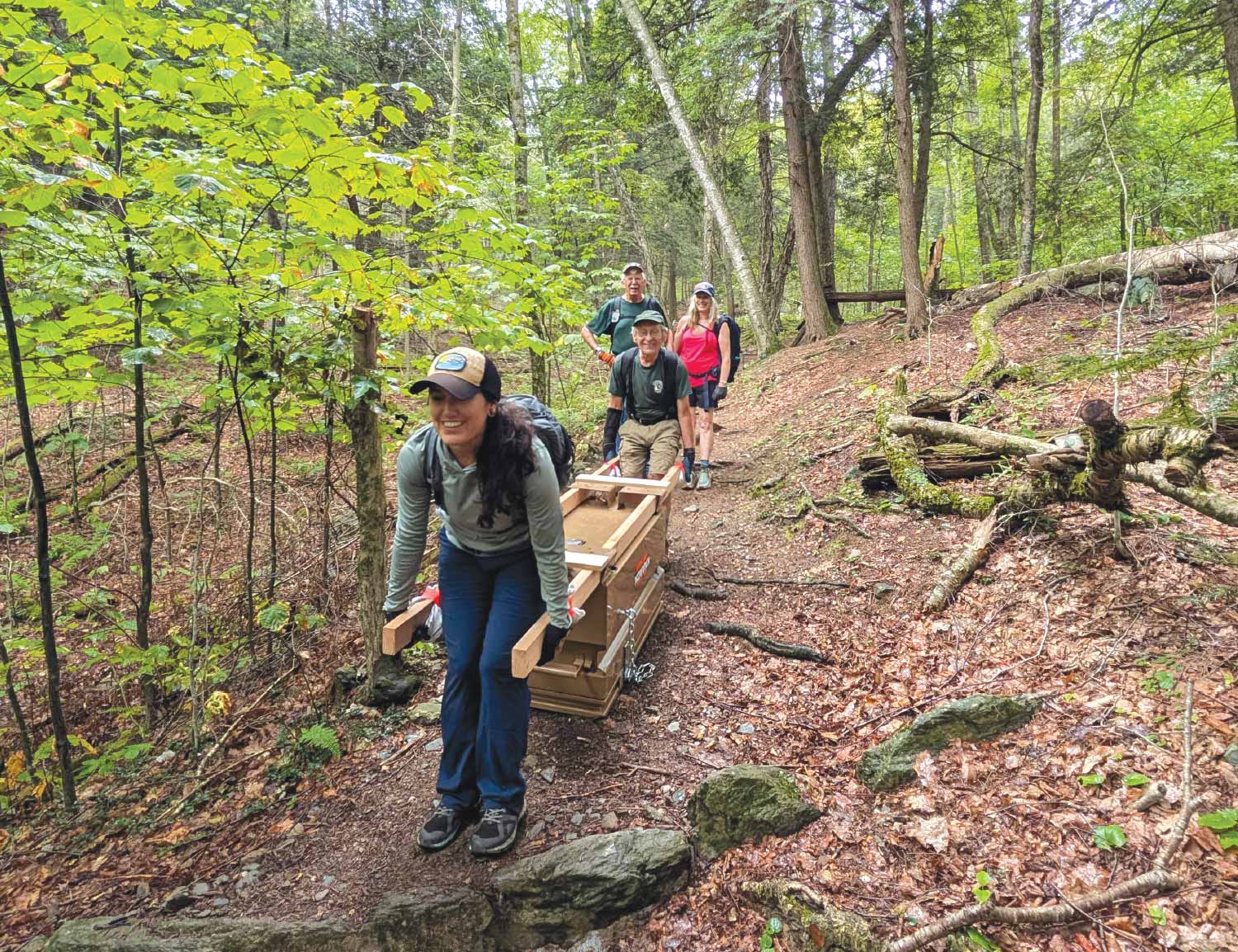
Tracy Lind and  A.T. volunteers carrying bear boxes
The ATC’s Tracy Lind and A.T. volunteers — including those from AMC-CT — carried bear boxes to the Sages Ravine campsite on the border of Connecticut and Massachusetts. Purchased through a generous anonymous donation and nearly 42 inches long and filled with ropes and chains, the boxes weighed 114 pounds each. A great deal of teamwork and dedication were needed to safely haul the boxes across the Trail’s rugged terrain.
Photo by Tracy Lind/ATC
The bear population along the Appalachian Trail and nationally is increasing, as is the number of A.T. visitors. According to information from the ATC’s partner BearWise®, spending time outdoors and in national parks and forests has never been more popular. The bear education and outreach program shares an impressive statistic: In 2021, 164.2 million people, or 54 percent, of Americans ages six and over participated in outdoor recreation at least once, which is the highest number on record.

The proximity of bears and hikers means the potential for human-bear interactions and conflict also increases. Additionally, bears have become habituated to humans — especially to human food.

Bears vs. Food Storage Technology
When Morgan Sommerville, the Appalachian Trail Conservancy’s Director of Visitor Use Management, began working at the ATC in 1983, minimizing interactions between bears and humans on the Appalachian Trail was only a small part of his job. But that has changed. “Finding a bear in the backcountry along the A.T. that hasn’t had some exposure to human food is pretty difficult,” Sommerville says. Visitors to the Trail often leave unused food and food waste behind at campsites. “Bears have a field day with the plentiful leftovers.” Even though hikers’ habits have improved — thanks to increased implementation of Leave No Trace (LNT) practices and better hiker education — the dramatic increase in the number of people using the A.T. has led to implementing various approaches over time to try to keep bears away from human food.

It’s essentially an ongoing race between bears learning how to get into food and technology for keeping them out of food.

repackaged snacks in plastic bags
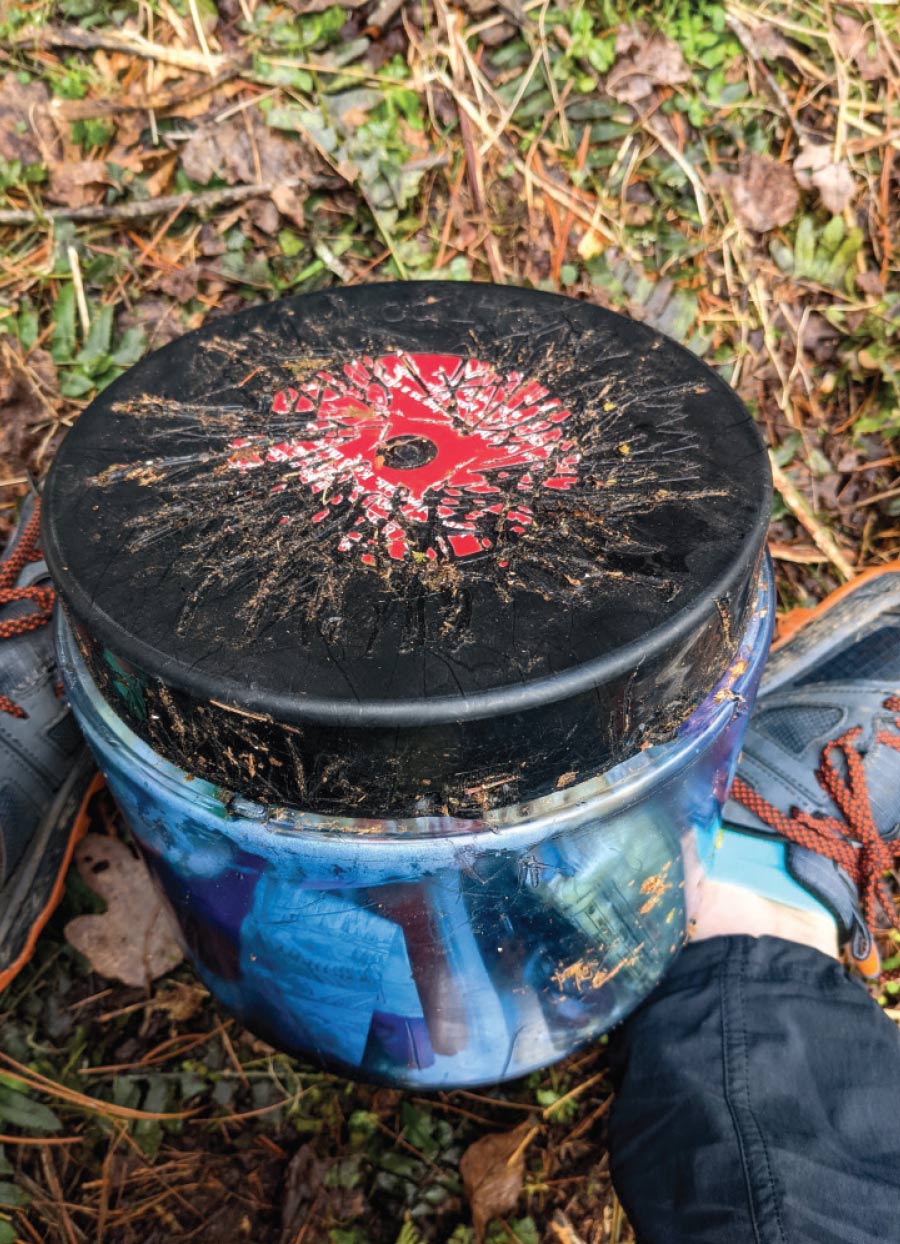
repackaged food in a canister
Repackaging food saves space so you only bring what you need and reduce the amount of trash you have to pack out. Keep your canister locked unless you’re actively taking food in and out of it. Bears will still try to break into the canisters — though this BearVault survived a relentless attempt — so at camp use the “Bearmuda Triangle” method. Cook at least 200 feet (70 big steps) from where you sleep and store your canister at least 200 feet from both where you cook and where you sleep.
PHOTOS BY CAITLIN MILLER/ATC (LEFT) AND THE ATC (RIGHT)
Adapting to Changing Conditions
In the 1990s, the ATC worked with its agency partners to install cable systems at many designated overnight sites. The systems are made up of pulleys that hikers use to lift food bags or even whole packs about 20 feet above the ground. Cable systems are effective, but they are prone to damage from the elements and user error and are expensive to maintain. And thanks to their adaptability, bears have learned to copy humans: they use the pulleys to get to the food and then teach their cubs. Some campers have used their own pole hangs or rope hangs to hoist their food bags, but getting the hangs up correctly isn’t always easy, and bears have learned how to snap the lines with their claws. 

The ATC and its partners provide bear boxes — metal lockers placed on the ground — for food storage at about 40 percent of A.T.-designated overnight sites. The boxes can be highly effective, as they are difficult for bears to open. However, their success depends on several factors. Campers must properly secure the closing mechanisms and, unfortunately, some leave garbage in the boxes. Additionally, because of the limited space in a bear box, campers can’t rely on having sufficient food storage space when they arrive at camp.

Another issue that affects bear and human interactions is that about 70 percent of overnight sites are user-created. Food storage options can’t be installed at those sites because they are not maintained by the ATC, its partner organizations, or the Maintaining Clubs. Because of the limitations of cables and boxes, the ATC’s official recommendation since 2016 is that Trail users carry their own bear canister. It is essentially a cylindrical mini food locker that is carried as part of a hiker’s pack. Most range from 9 to 12 inches tall and 8 to 12 inches across. Currently, they are the most bear-resistant food storage tool available.

“A bear canister is the surest way to go. I know my canister is going to work, and that it’s going to be available to me,” advises Caitlin Miller, the ATC’s Information Services Manager. Miller is often the first point of contact for many people interested in hiking the Trail. She’s also an accomplished hiker and camper. “With more bears on the Trail and more hikers on the Trail, there’s going to be more human-bear encounters,” Miller says. “The Trail has changed, and hikers need to adapt in the same way they would adapt to any other changing condition. That means carrying a bear canister.” 

The ATC’s data gathering shows that bear canister adoption is growing. “We have been working for nearly a decade to create a paradigm shift to most A.T. campers using bear canisters,” Sommerville says “This is not just an A.T. shift, but a national shift as well.”

new bear box installed
A new bear box — purchased through an anonymous gift — was installed by the Mountain Club of Maryland (MCM) at Darlington Shelter.
Photo courtesy of MCM
The ATC recently received a gift from an anonymous donor to support food storage along the Trail. The donor, a thru-hiker, became aware firsthand that many A.T. campers do not properly store their food. The generous gift, payable over two years, will help the ATC respond to requests from Maintaining Clubs to replace existing bear boxes along the Trail. 

“The donor drew from his own hiking experiences and observations to try to make the A.T. a better and safer experience for both hikers and bears,” says Thomas Smith, Associate Director of Development, who coordinated the gift. Gifts like these bridge the gap until all A.T. campers responsibly store their food by their own unaided efforts, which is essential in reaching and maintaining the optimal A.T. experience for both Trail users and wildlife.

man giving bear safety presentation
The ATC and its partners incorporate bear safety into many of their hiking and camping presentations.
Photo by Emily Fussell
Data-based Approaches for the Future
The ATC encourages all hikers to sign up on atcamp.org to help reduce overcrowding on the Trail and receive urgent alerts via text or email. Since 2017, thru- and section hikers can also opt in to take an end-of-season survey, which now includes questions about food storage practices. “The survey has a high response rate,” says Monica Mogilewsky, Data Manager for the ATC’s Visitor Use Management team. In 2024, 19 percent of thru-hikers said bear canisters were their most frequently used food storage method. That is up from 14 percent in 2022. The use of agency-provided food storage, such as bear boxes, has remained stable at about 10 percent. “If more visitors use successful food storage, the more we break the chain of bears being habituated to human food, and the more successful we are at keeping bears wild on the A.T.,” adds Mogilewsky.  

Using bear canisters also is consistent with the overarching A.T. management philosophy, as outlined in the 1981 Comprehensive Plan. It encourages hikers’ self-reliance and having minimal impact as they reconnect with nature.  Sommerville cites a key sentence in the plan: [The A.T.] is a means of sojourning among these lands such that the visitors may experience them by their own unaided efforts.

“We’re thrilled that hikers are using the Appalachian National Scenic Trail,” he says. “We want them to do it in a way that has as little impact as possible and does as much as possible to help preserve the Trail for another one hundred years into the ATC’s second century.”

For more information about bear safety and food storage on the Trail, visit appalachiantrail.org/bears