Contributors
Contributors

We are driven to conserve what we value, and we value what we know…
Tyler Nordgren

IN MY 11 YEARS AS EDITOR, I HAVE HAD THE PRIVILEGE to work with countless, talented contributors — not to mention our graphic designer Traci Anfuso-Young, without whom I would only be one half of a dynamic duo. These writers, photographers, and artists pour their passion for the A.T. into their work. So, I am thrilled that we are taking some big strides with a fresh new design, starting with this issue, to bring you the voices and images that tell the extraordinary story of the Trail as a part of the “Wild East” — from the birds that soar above to the mountains and forests on the ground.
Wendy K. Probst / Editor in Chief

Kim O’Connell
Kim O’Connell writes about science, history, conservation, and sustainability for a range of national publications. She has served as a writer-in-residence at Acadia and Shenandoah national parks and teaches in the Johns Hopkins University Master’s in Science Writing program. “As a writer, I love how metaphorical the Appalachian Trail is — how it offers important life lessons about taking things one step at a time, being brave enough to venture into new territory, and trusting a long and winding path,” she says. “I’m always excited to get back on the Trail and learn those lessons all over again.”
Kim O’Connell writes about science, history, conservation, and sustainability for a range of national publications. She has served as a writer-in-residence at Acadia and Shenandoah national parks and teaches in the Johns Hopkins University Master’s in Science Writing program. “As a writer, I love how metaphorical the Appalachian Trail is — how it offers important life lessons about taking things one step at a time, being brave enough to venture into new territory, and trusting a long and winding path,” she says. “I’m always excited to get back on the Trail and learn those lessons all over again.”

Tyler Nordgren
In this issue, we present the eye-catching artwork of Dr. Tyler Nordgren, an unusually gifted artist, astronomer, and author. Tyler is well-known for his contemporary series of “Milky Way” posters for dozens of national parks and his series on the 2017 eclipse, which are now part of the Smithsonian collection. His commissioned artwork of the Appalachian Trail presents some of the Trail’s attributes in a fresh new way, reminiscent of vintage “See America” posters. “We are driven to conserve what we value, and we value what we know,” says Tyler. “For me, this project helps share the wild beauty of the eastern U.S. and the need to protect and conserve it just as we would the canyons, arches, and mountains out west.”
In this issue, we present the eye-catching artwork of Dr. Tyler Nordgren, an unusually gifted artist, astronomer, and author. Tyler is well-known for his contemporary series of “Milky Way” posters for dozens of national parks and his series on the 2017 eclipse, which are now part of the Smithsonian collection. His commissioned artwork of the Appalachian Trail presents some of the Trail’s attributes in a fresh new way, reminiscent of vintage “See America” posters. “We are driven to conserve what we value, and we value what we know,” says Tyler. “For me, this project helps share the wild beauty of the eastern U.S. and the need to protect and conserve it just as we would the canyons, arches, and mountains out west.”
Marina Richie
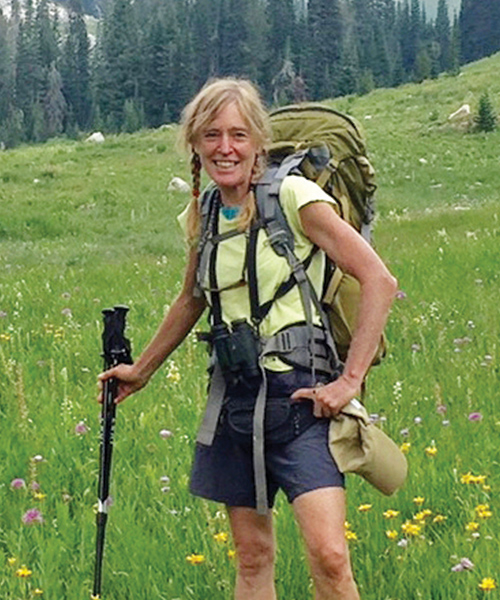
As a child, Marina Richie watched raptors at Hawk Mountain Sanctuary in Kittatinny, Pennsylvania with her father Dave Richie — a former National Park Service official who played an important role in protecting the Trail. Later, Marina backpacked the Monson to Katahdin section of the Trail with him in Maine. “Every bird of the A.T. is magnificent — from the cerulean warbler winging from the Appalachians to the Andes, to the pileated woodpecker drumming on a tree,” she says. “My father had this knack for finding rejuvenation in bird song no matter how arduous his A.T. hike. Writing this piece connected me even more deeply to him, and to the grassroots legacy of the A.T. that gives me hope for the future of our imperiled birds.”
As a child, Marina Richie watched raptors at Hawk Mountain Sanctuary in Kittatinny, Pennsylvania with her father Dave Richie — a former National Park Service official who played an important role in protecting the Trail. Later, Marina backpacked the Monson to Katahdin section of the Trail with him in Maine. “Every bird of the A.T. is magnificent — from the cerulean warbler winging from the Appalachians to the Andes, to the pileated woodpecker drumming on a tree,” she says. “My father had this knack for finding rejuvenation in bird song no matter how arduous his A.T. hike. Writing this piece connected me even more deeply to him, and to the grassroots legacy of the A.T. that gives me hope for the future of our imperiled birds.”
Amanda Wheelock
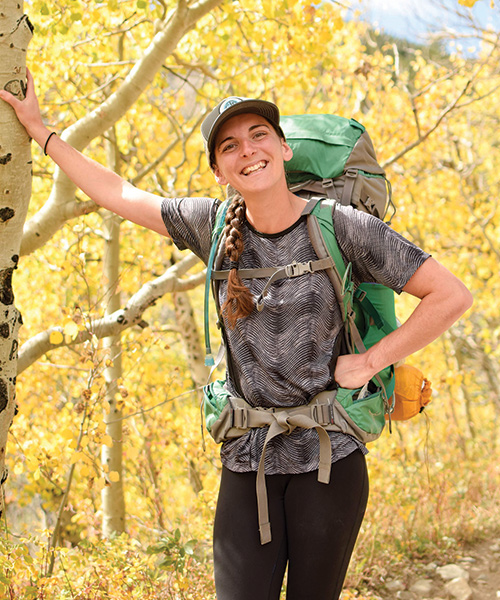
The A.T. wove its way into Amanda Wheelock’s life when she moved from Georgia to New Hampshire to attend Dartmouth College. There, she worked on a Trail crew, taught backpacking, and hiked from Hanover to Moosilauke because it was “tradition.” She quickly discovered that her love of long-distance trails was more than just a college fling. Amanda now works for the Continental Divide Trail Coalition and stays connected to her first love by volunteering on the Appalachian Trail Conservancy’s Next Generation Advisory Council. “Writing about winter hiking toward the end of a year jam-packed with change gave me a welcome opportunity to look back at a wonderful weekend spent on the A.T.”
The A.T. wove its way into Amanda Wheelock’s life when she moved from Georgia to New Hampshire to attend Dartmouth College. There, she worked on a Trail crew, taught backpacking, and hiked from Hanover to Moosilauke because it was “tradition.” She quickly discovered that her love of long-distance trails was more than just a college fling. Amanda now works for the Continental Divide Trail Coalition and stays connected to her first love by volunteering on the Appalachian Trail Conservancy’s Next Generation Advisory Council. “Writing about winter hiking toward the end of a year jam-packed with change gave me a welcome opportunity to look back at a wonderful weekend spent on the A.T.”