



Non-native invasive plants can quickly take over an area, outcompeting native plants for resources and wreaking havoc on entire ecosystems. Dan Ryan, ATC’s Vice President of Conservation and Government Relations, calls non-native invasive species “one of the fastest ways to permanently change the A.T. landscape.”
The Southern Appalachians are no stranger to the scourge of non-native invasive plants, but Hurricane Helene has made it a more urgent problem. The massive losses of tree canopy and native vegetation, along with extensive terrain damage, have created an opening for troublesome plant species to flourish. NASA satellite data measuring “greenness” of vegetation shows that Helene transformed 81,500 acres of the Appalachian Trail (an area the size of Philadelphia).

Over the next four years, the Strike Team will treat and monitor plants like Chinese silvergrass (Miscanthus sinensis), multiflora rose (Rosa multiflora), Japanese knotweed (Reynoutria japonica), and tree of heaven (Ailanthus altissima) in Georgia, North Carolina, Tennessee, and Virginia. The ATC and a number of A.T. Clubs along the entire Trail have long been treating and monitoring non-native invasive species as part of general Trail management and natural resource work. The Strike Team differs in that this is the first ATC initiative to focus solely and intensively on non-native invasive species.
PHOTOS BY BEN EARP

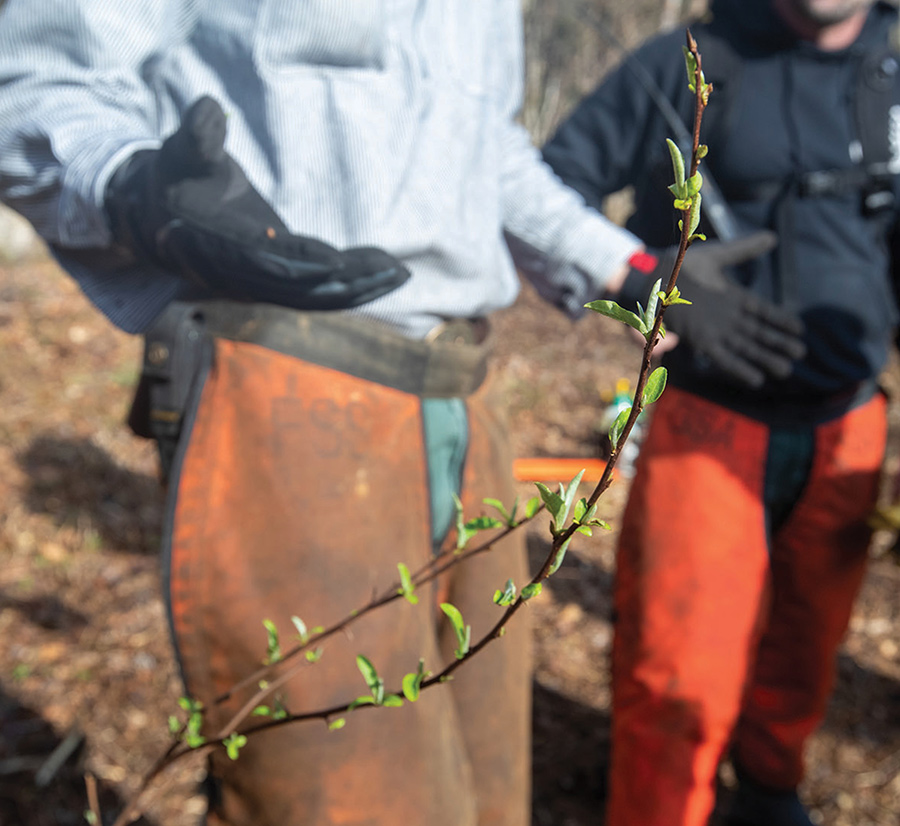
And it’s not just the native plants that suffer. Many animals rely on those plants for forage and cover. Native plants support hundreds of local and migrating wildlife species, which helps to maintain the vital biodiversity in an ecosystem. There also are instances where species have evolved to rely solely on one native plant for food, such as some moth and butterfly species whose larvae serve as protein-rich meals for birds. Non-native invasive plants create monocultures that support significantly fewer animal species. Over time, this means fewer native plants, as well as fewer birds, insects, reptiles, amphibians, and mammals.
PHOTOS BY BEN EARP


Halting the spread of non-native invasive plants and preventing harm to native species requires strategy and planning. “There are many rare species that do occur along the Trail,” explains botanist and ecologist Gary Kauffmann, who spent over 32 years with the USDA National Forest in North Carolina before retiring. “You want to maintain or improve habitat for those species, but if you’re [not carefully] removing the non-native invasive or using chemicals, you could impact the rare species.”
The Strike Team is working closely with the USDA Forest Service to determine where and how to focus their efforts. In addition to using the appropriate treatment method, this could mean prioritizing an area with a concentration of rare native species by scheduling the removal of an invasive plant before it produces seeds or before a rare native plant emerges in the spring.
Garlic mustard, a biennial herb that tends to crowd out native wildflowers, is often pulled by hand in early-to-late spring before it develops seed pods. Japanese knotweed, with its vast underground network of asexually reproducing rhizomes, is generally treated with sprays or stem injections at specific times in its growing cycle.
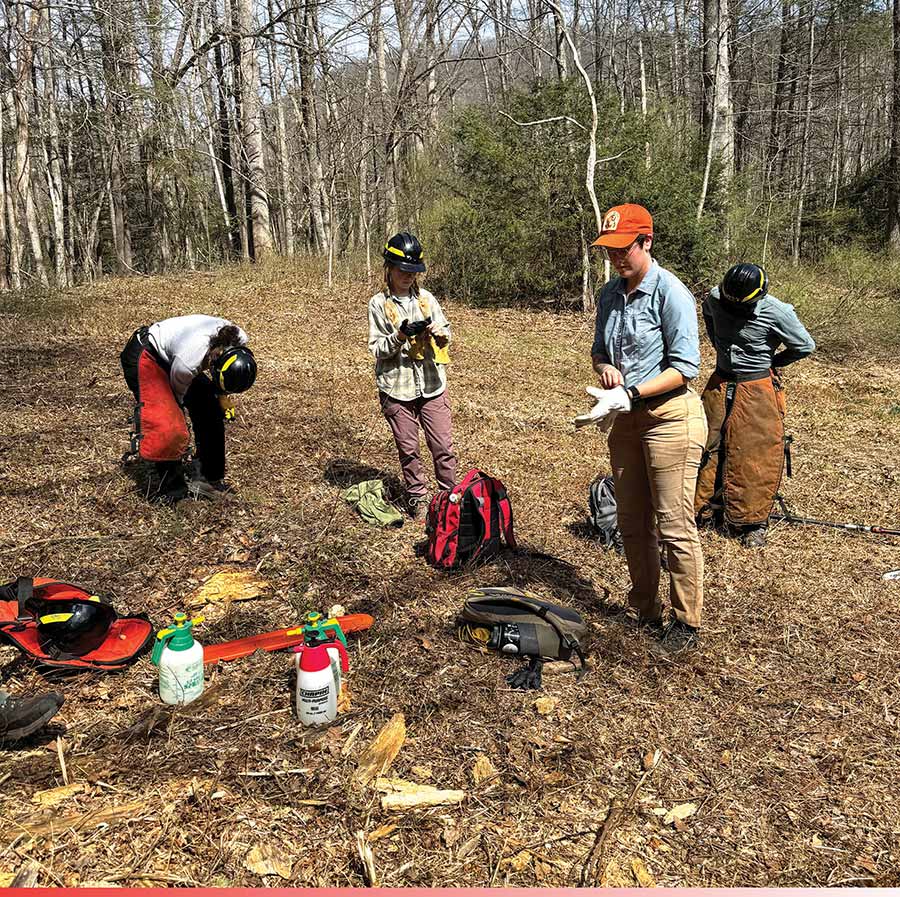
PHOTO BY EMILY POWELL/ATC
To manage non-native invasive species requires repeated efforts. Even if a site is cleared, a new infestation can always occur. Seeds can remain viable in the soil seed bank for years, and they can also be reintroduced — stuck to an unwitting hiker’s gear or deposited by wind or by bird. “A lot of this is spread by wildlife,” says Drury. “So we have to do constant inventory and constant response. We call it EDRR, early detection and rapid response. Find it quickly and you might be able to keep it under control. Let something go for five years, and you’re likely going to spend hundreds of times more money and resources to try to get that same population under control.”
Despite the challenges, these efforts can lead to noticeable improvements. Paul Curtin, Appalachian Trail Supervisor and Vice President of the Carolina Mountain Club (CMC), describes the transformation of Max Patch through previous non-native invasive species work by the ATC, CMC, and other partners and volunteers. “It’s incredible. If you look at the before and after, the amount of wildflowers and native plants that are growing like crazy everywhere. All through the whole growing season, we get different kinds of flowers. Now we have birds and bees and butterflies and all the pollinators that never were there before. People just enjoy it so much, and it makes them respect it so much more because it looks so pretty.”
“It’s a growing problem,” says Marian Orlousky, ATC’s Director of Science and Stewardship. “The challenge of invasive species is not going to go away, and we’re always trying to scale up thoughtfully and responsibly in order to address it.” Orlousky says that the ATC is actively seeking funding to expand its non-native invasive species strike team model to other areas.
Meanwhile, the ATC continues to work with the USDA Forest Service, A.T. Clubs, volunteers, and other partners to minimize impacts from this landscape-altering threat. “We’re currently training the Georgia Appalachian Trail Club,” says Drury. “They want to run their own program. We’re also doing a series of trainings with Carolina Mountain Club. And we’re doing a garlic mustard pull at Lemon Gap next month with them.”
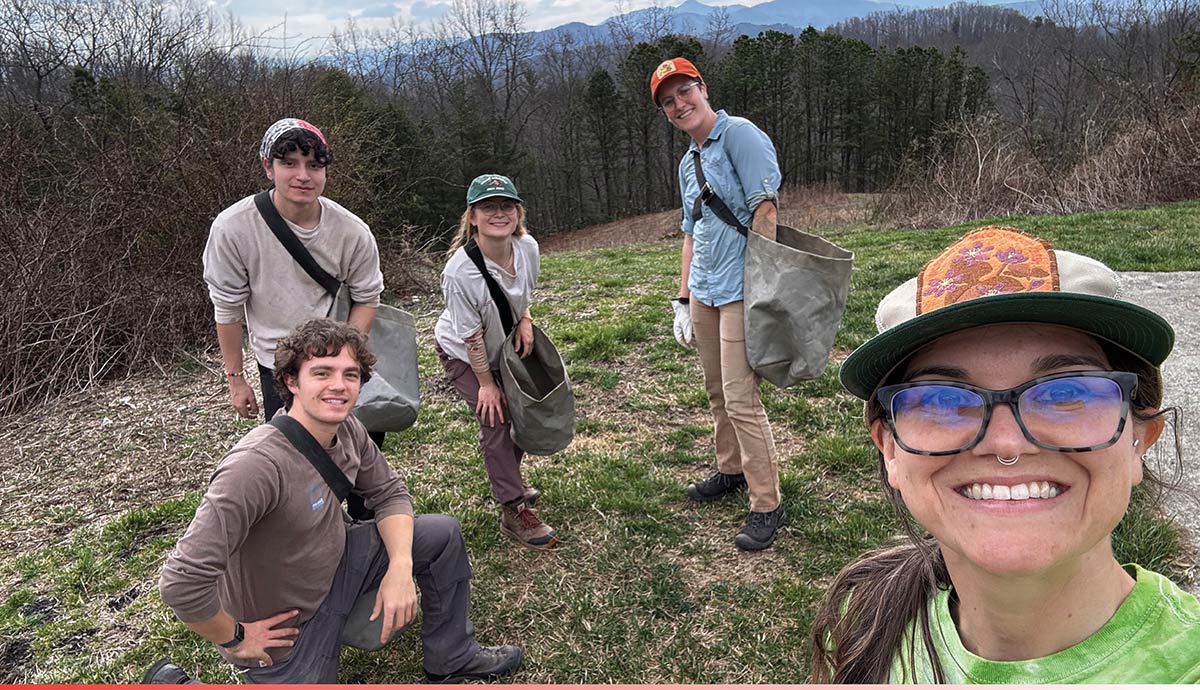
PHOTO BY EMILY POWELL/ATC
Ultimately, a proactive approach to the non-native invasive species threat helps preserve the biodiversity and resiliency of the A.T. Ryan leaves us with these parting thoughts: “Protecting the Trail means protecting the forest around it. In order to do that, we need to have resilient ecosystems that can address stressors like climate and additional storms down the path and the pests in and of themselves. The more resilient we can create the conditions of the forest that surrounds the Trail, the stronger those ecosystems can be on their own. It ties back into the ATC’s mission of maintaining the treadway and the A.T. experience as a whole.”